
Part 22: Gradient Descent: How Neural Networks Find Better Weights
Understand how gradients, learning rate, and weight updates help models reduce error and improve their predictions.
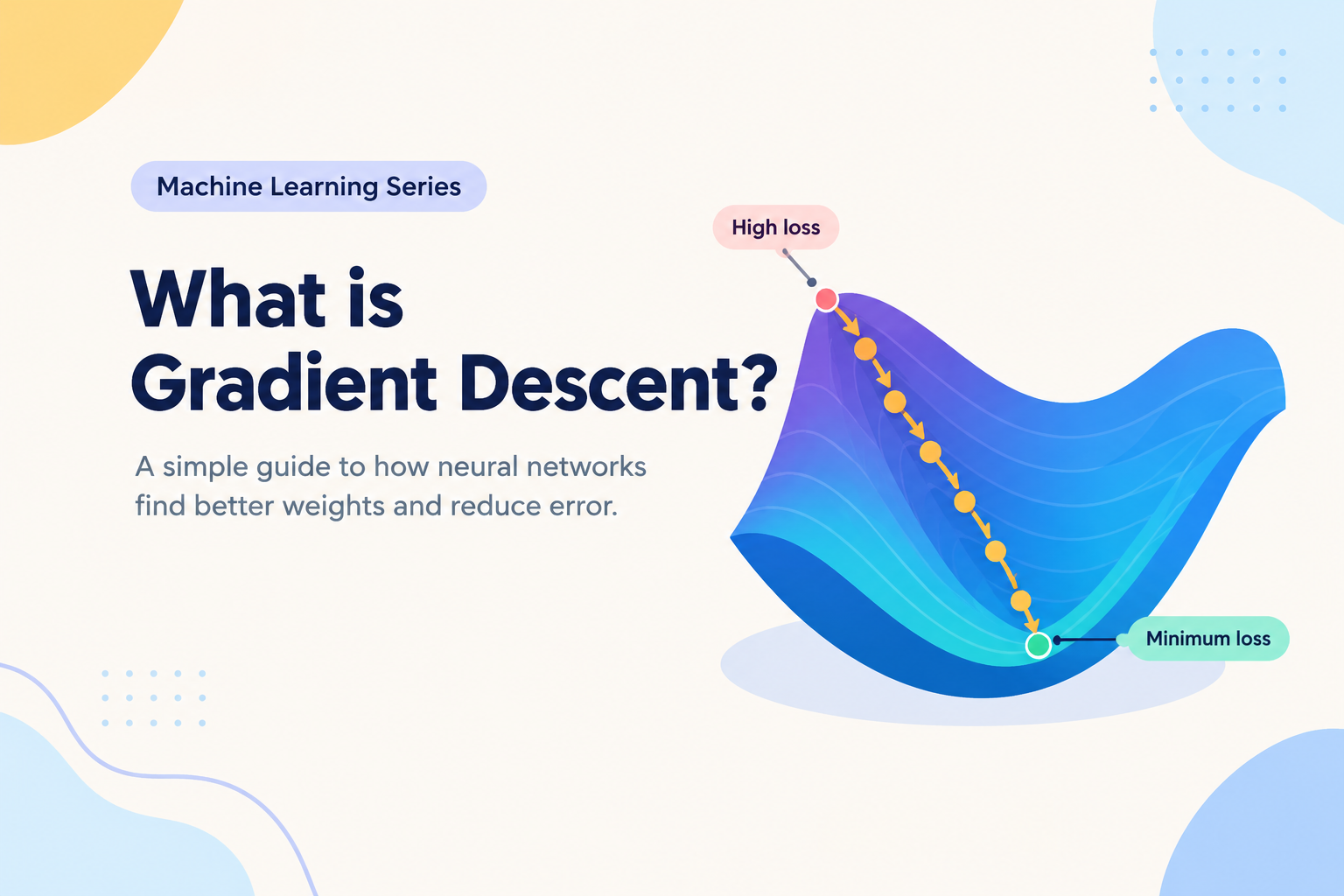
Imagine you are standing on top of a mountain, but it's completely dark. 🌙
Your goal is to reach the lowest point in the valley.
You can't see the entire path, so what would you do?
You might take a small step, check which direction goes downward, and continue taking steps in that direction until you reach the bottom.
This is the basic idea behind Gradient Descent.
In machine learning, Gradient Descent helps a model find better parameter values by gradually moving in a direction that reduces the error (loss).
🤔 What Is Gradient Descent?
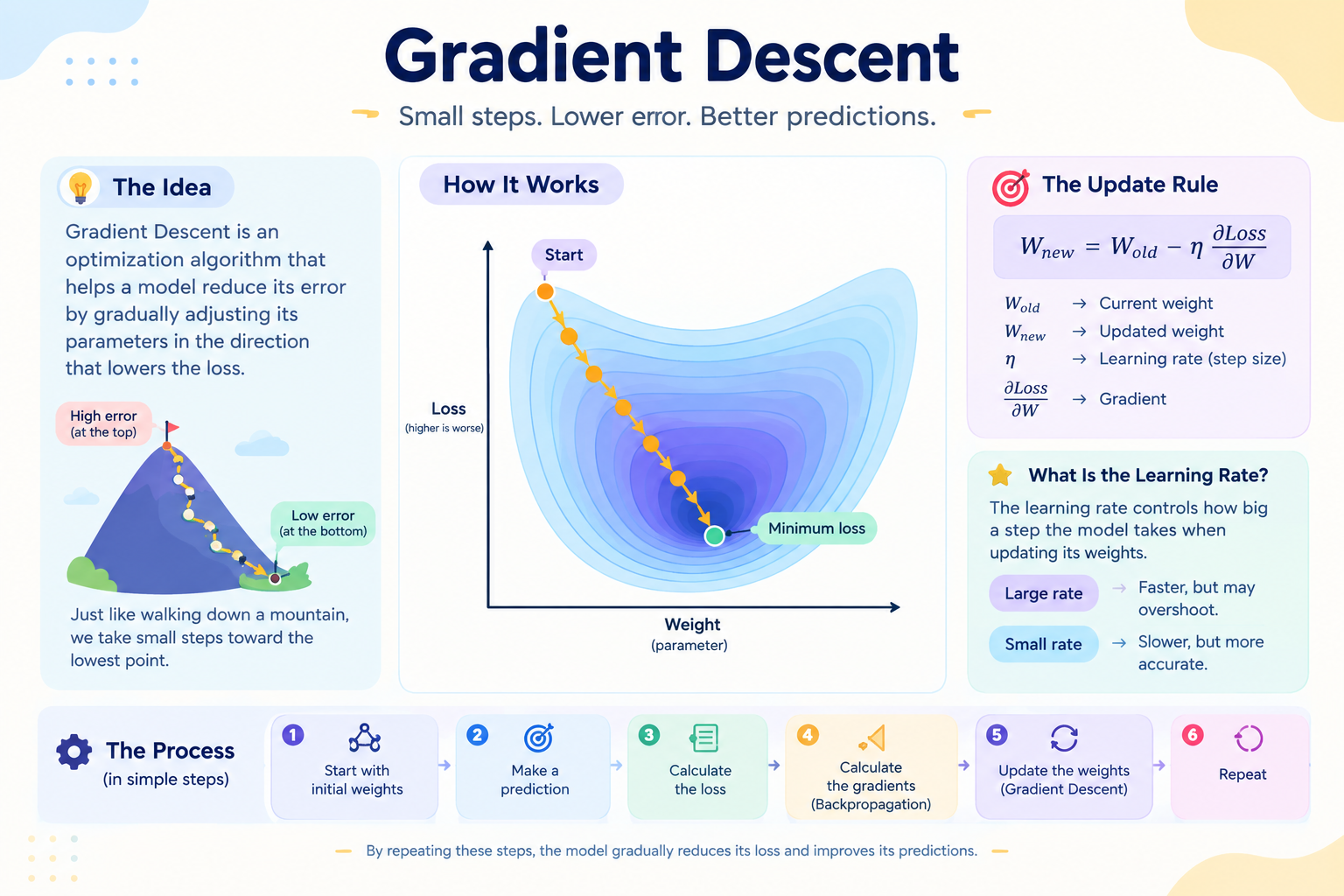
Gradient Descent is an optimization algorithm that helps a machine learning model reduce its error by gradually adjusting its parameters in the direction that lowers the loss.
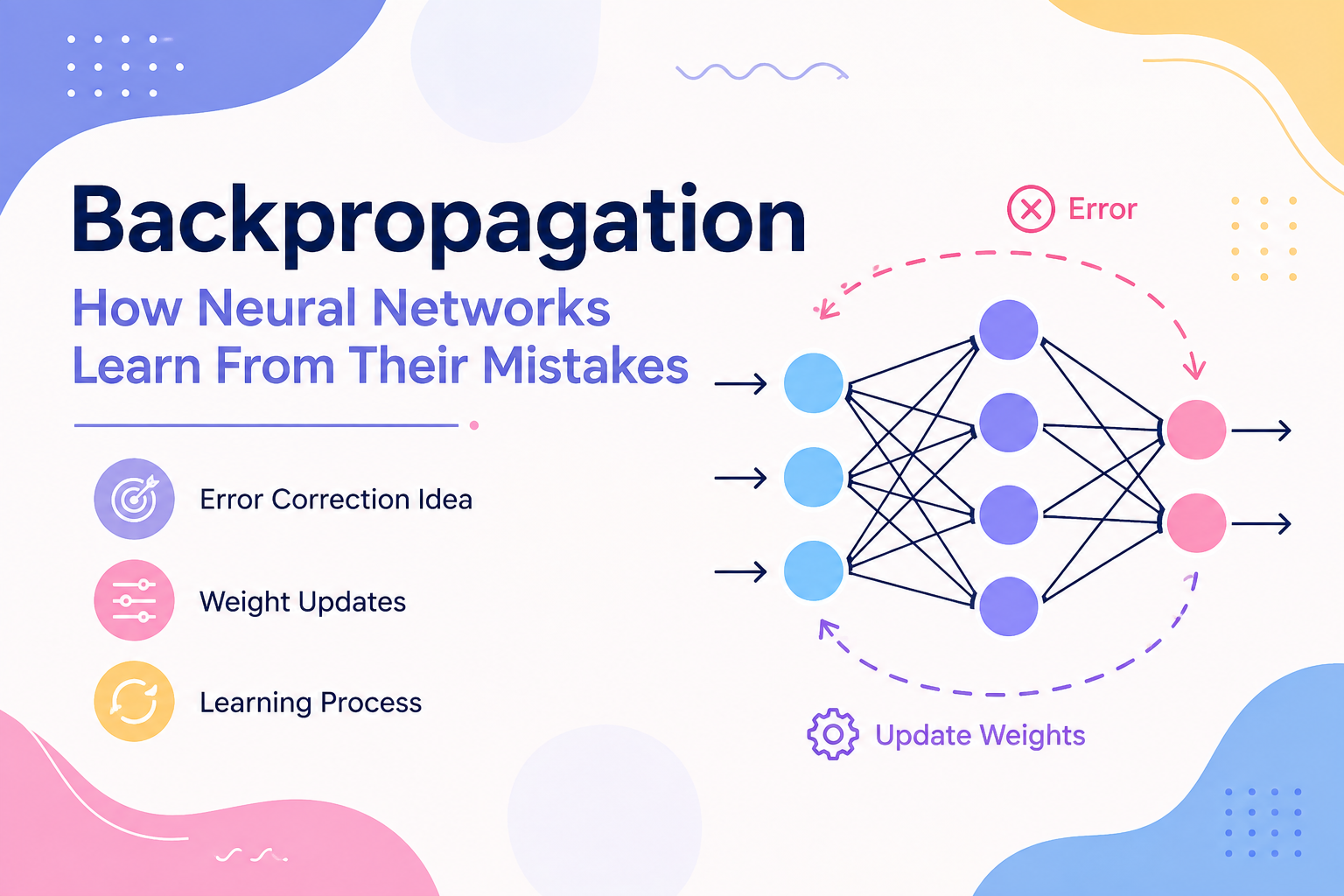
Remember our previous blog on Backpropagation?
Backpropagation calculates the gradient for each weight, showing how a change in that weight affects the loss.
Gradient Descent then uses these gradients to update the weights in a direction that reduces the loss.
In simple terms:
"Backpropagation calculates the gradients. Gradient Descent uses those gradients to update the weights."
Together, they help neural networks learn from their mistakes.
⛰ Think of It Like Walking Down a Mountain
Imagine the loss of a model as a mountain landscape.
The height represents the amount of error.
High point → High error ❌
Low point → Low error ✅
Our goal is to reach the lowest point, also called the minimum.
But the model doesn't know where the lowest point is.
So, it uses the gradient to determine which direction leads toward increasing loss and then moves in the opposite direction, toward lower loss.
This repeated process of moving toward lower loss is called Gradient Descent.
🧭 What Does “Gradient” Mean?
A gradient tells us how the loss changes when a model parameter, such as a weight, changes.
Think of standing on a hill.
The gradient points toward the direction where the loss increases most rapidly.
Since we want to reduce the loss, Gradient Descent moves in the opposite direction of the gradient.Here:
The weight-update formula is:
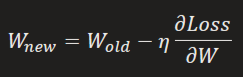
Here:




The formula basically says:
"Take the current weight and adjust it in the direction that reduces the loss."
⚖️ Weights vs. Gradients
It is easy to confuse these two, but they have different roles.
| Weights | Gradients |
What are they? | Numbers that control how strongly inputs influence the model's output. | Numbers that tell us how changing a weight affects the loss. |
Purpose | Help the model make predictions. | Tell the model how the weights should change. |
Example | A weight might be 0.5. | Its gradient might be -0.2. |
During training | They are updated. | They are calculated from the loss. |
So remember:
Weights → Make predictions
Gradients → Guide corrections
Gradient Descent → Updates weights
👣 What Is the Learning Rate?
The learning rate is a value that controls how big a step the model takes when updating its weights.
Think of it as the size of your steps while walking down a mountain.
Large learning rate 🚶
The model takes bigger steps.
It may move toward the minimum faster, but it could overshoot the lowest point or make the training unstable.
Small learning rate 🐢
The model takes smaller steps.
It can make more careful adjustments, but it may take much longer to reach a good solution.
Therefore, the learning rate needs to be chosen carefully so the model can reduce its loss efficiently.
🔁 How Does Gradient Descent Work?
The process can be simplified into a few steps:
1. Start with initial weights:
The model begins with some initial values.
2. Make a prediction
The model uses those weights to produce an output.
3. Calculate the loss
We measure how far the prediction is from the correct answer.
4. Calculate the gradients
Backpropagation calculates how each weight affects the loss.
5. Update the weights
Gradient Descent uses the gradients to adjust the weights in a direction that reduces the loss.
6. Repeat
The model repeats these steps for many iterations, gradually reducing the loss.
🍳 A Simple Real-Life Example
Imagine you're cooking a dish for the first time.
You taste it and realize:
“It's too salty.”
So, next time, you add less salt.
You taste it again:
“Now it's too bland.”
So you make another small adjustment.
After several attempts, you get the taste closer to what you want.
That's similar to Gradient Descent.
The difference in taste is like the error, while changing the amount of an ingredient is like changing a model's weights.
The information about how much an ingredient should be changed is similar to a gradient, while the size of your adjustment is influenced by the learning rate.
The goal isn't to get everything perfect in one attempt, but to gradually improve through repeated corrections.
🚀 Final Thoughts
Gradient Descent may sound complicated, but its core idea is simple:
Measure the error, calculate the gradients, adjust the weights, and repeat.
By making these adjustments repeatedly, a model can gradually reduce its loss and improve its predictions.
This combination of loss, gradients, and weight updates is one of the fundamental ideas behind how machine learning models learn.
🔮 Coming Up Next
In the next blog, we’ll explore the Types of Gradient Descent and understand how Batch, Stochastic, and Mini-Batch Gradient Descent help neural networks learn and update their weights efficiently.